
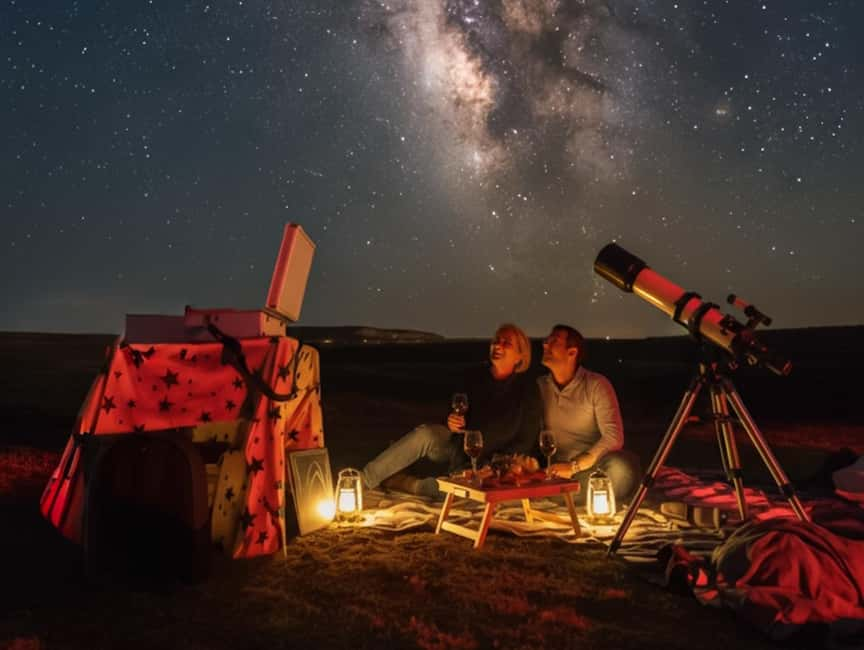
Review · TELESCOPE
Tabernas Desert: Stargazing with Telescopes
The desert sky puts on a grand show. This two-hour Tabernas Desert stargazing experience combines a dark setting, a certified astronomy guide, and two serious telescopes for $41 per person. I like the clear mix of science and storytelling, and I like that you get a group night photo to remember the evening.
Guide Gonzo receives especially warm praise for his energy, patience, and ability to keep both children and adults interested. The main thing to consider is the weather: wind can make telescope viewing tricky, and the desert gets cold after sunset, so warm clothing is essential.
Key points to know before booking
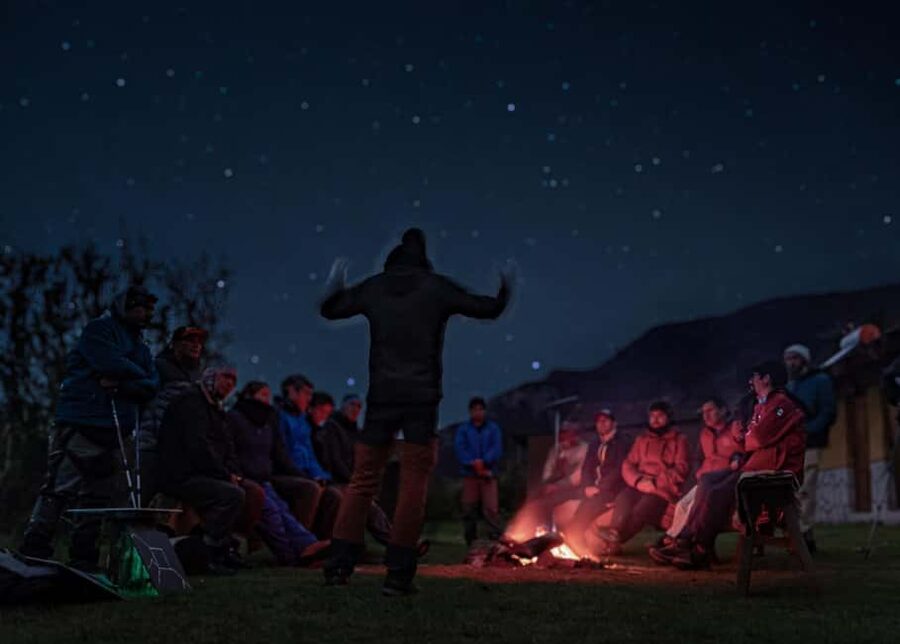
- The start time follows sunset: The activity begins 45 minutes after sunset, with the exact time confirmed about two days beforehand.
- Gonzo is a major part of the experience: His enthusiastic explanations and easy storytelling work well for families, teenagers, and adults.
- You use two professional telescopes: The Explore Scientific 305 and Seestar S50 are used for planets, star clusters, binary stars, and other night-sky targets.
- The moon can be a highlight: When visible, its craters can be seen in close detail through the telescope.
- Bring warm clothes and expect ground-level seating: Blankets are supplied, but chairs are not normally included.
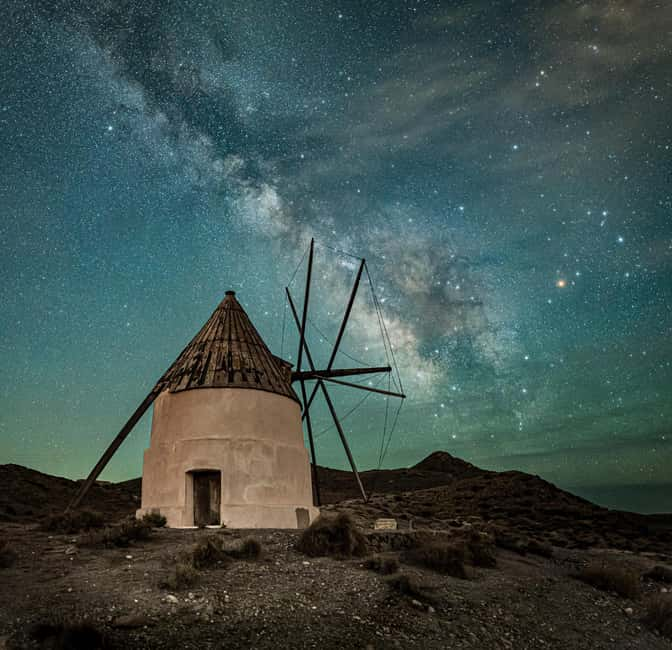
- The setting is far from city glare: The Tabernas Desert gives the sky a darker backdrop for learning constellations and spotting faint objects.
Why the Tabernas Desert works so well at night
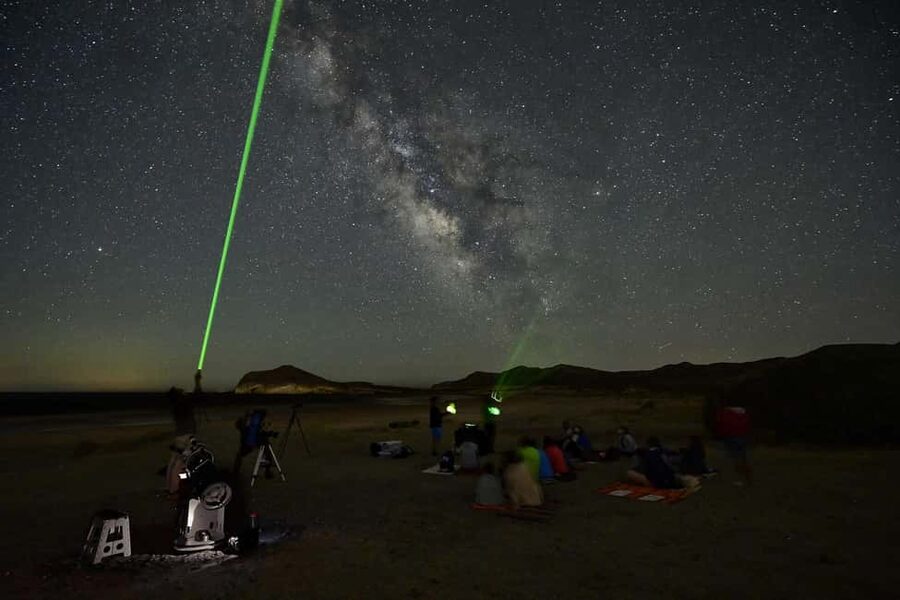
The Tabernas Desert is best known for its dry scenery and film connections, but after sunset its most useful feature is the lack of city light. Darkness matters in astronomy. It lets more stars appear to the naked eye and gives a telescope a better chance of showing faint clusters and distant objects.
You begin at one of three possible meeting points near Tabernas. The exact meeting place depends on the option you book, so check the confirmation carefully. From there, the group takes a short walk of about five minutes into the desert.
That walk is simple, but it is worth treating it as part of the experience. You are leaving streetlights and buildings behind, and your eyes need time to adjust. Avoid using your phone more than needed during this first stretch. The darker your surroundings, the more stars you will notice.
The setting is not presented as a luxury observatory. You are out in the open, sitting or lying on blankets on the ground. That gives the evening a relaxed, direct connection with the sky, but it is not ideal for anyone who has trouble getting down to the floor or standing back up.
More Telescope Stargazing in Spain:
- Teide by Night: Sunset & Stargazing with Telescopes Experience
★ 4.5 · 1,492 reviews - Teide National Park: Guided Large Telescope Stargazing Tour
★ 4.9 · 319 reviews - Cavalleria: Guided Stargazing at the Beach with Telescope
★ 4.9 · 87 reviews
The five-minute walk and the first look upward
The walk itself takes around five minutes, followed by roughly 105 minutes of guided astronomy. The guide uses this time to help you get your bearings before focusing on the telescope.
I like this approach because stargazing is easier when you first learn to look with your own eyes. You will work out which main constellations are visible on your particular night, rather than simply waiting for the guide to point a telescope at one object after another.
The activity also introduces basic positional astronomy. In plain terms, you learn how the sky is arranged and how to use familiar points, such as the North Star, to orient yourself. One particularly useful example from the evening is learning why the North Star appears fixed while other stars seem to move across the sky.
This makes the experience more than a series of impressive telescope views. You leave with a simple method for finding your way around the night sky. That is useful later, even if you are standing on a beach, in a countryside village, or on your hotel terrace.
Two telescopes, two ways to see space
The equipment is one of the strongest reasons to consider this activity. The setup includes an Explore Scientific 305 telescope with a 305 mm aperture, along with a Seestar S50 smart telescope.
The larger telescope is suited to direct observation through an eyepiece. The Seestar S50 adds a modern electronic approach. Together, the two instruments give the guide flexibility when choosing objects and explaining what you are seeing.
On a good night, you might look at:
- The moon and its craters
- Jupiter and some of its moons
- Saturn and its rings when visible
- Open star clusters
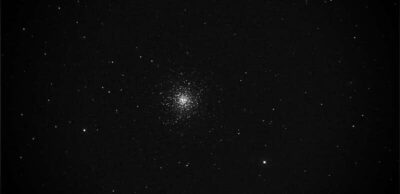
- Globular clusters
- Binary stars
- Nebulae
- A galaxy, depending on the season and conditions
The exact objects change with the date, the weather, and the position of the planets. You should not book expecting one fixed list of sights. That changing element is part of real astronomy, but it also means the experience depends on what the sky offers on your evening.
The moon can be especially striking. Instead of seeing it as a bright disk, you can examine craters and hear how they formed over long periods. When planets are visible, the telescope can turn small points of light into recognizable worlds. One evening included Saturn with its rings and the shadow cast across the planet, while another included Jupiter, its rings as reported by the group, and several moons.
Gonzo brings the science down to earth
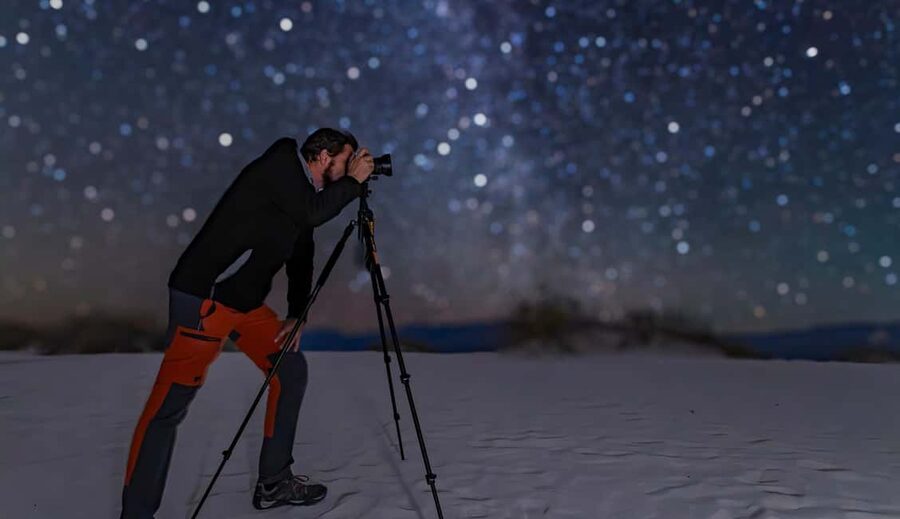
The strongest praise centers on Gonzo, the guide. His style is energetic and warm, but the important point is that he can explain astronomy without making it feel like a classroom lecture.
He has worked well with families, including children and teenagers. Younger visitors can enjoy the thrill of spotting a planet, while adults can follow the explanations about stars, orbits, and the place of Earth in the universe. His storytelling also connects astronomy with human culture, showing why people have watched the sky and built stories around it for thousands of years.
I particularly like that the activity covers both fact and feeling. You learn how to identify constellations, but you also consider why looking at the stars has been part of human life for so long. That balance keeps the session from becoming either a dry science lesson or a vague, overly romantic night outdoors.
Several evenings included clear explanations of the North Star, Orion, star clusters, and the Hercules cluster. One particularly memorable session also included the Seven Sisters, a group of satellites crossing the sky, and Orion’s Nebula. These details show how much can appear during two hours when conditions cooperate.
The guide’s patience matters, too. Telescope viewing can take time, especially when several people are waiting for their turn. A calm guide who explains what to look for makes the process more rewarding for first-time observers.
More Desert Stargazing Safaris in Spain:
- Stargazing Night in the Tabernas Desert
★ 5.0 · 18 reviews - Dubai Red Dunes ATV, Camels, Stargazing & 5* BBQ Al Khayma Camp
★ 5.0 · 21,620 reviews - Dubai: Sunset Camel Trek, Al Khayma Camp, Stargazing & BBQ
★ 4.8 · 2,588 reviews - Dubai: Overnight Safari, Dinner, Stargazing & Al Khayma Camp
★ 4.8 · 2,562 reviews
What you may see through the telescope
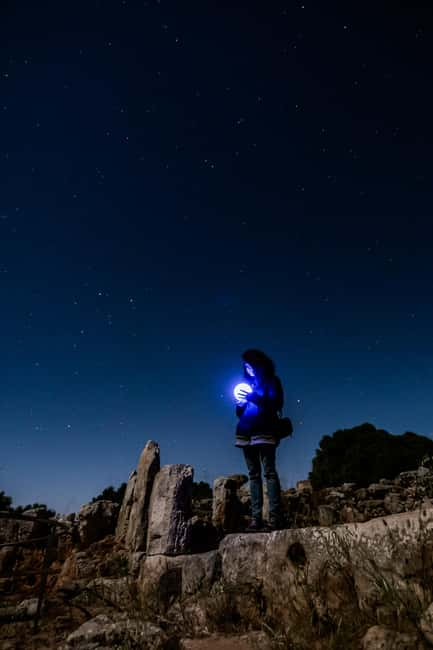
The night sky changes by season, so the viewing list cannot be guaranteed. Still, the reported observations give you a useful idea of the range.
The moon is often an excellent target because its bright surface and visible craters are easy to appreciate. Jupiter can offer a glimpse of its moons, while Saturn is especially rewarding when its rings are positioned well for viewing.
Star clusters are another strong feature. Open clusters show groups of stars spread across the field of view, while globular clusters appear more tightly packed. Binary stars give you a chance to see two stars together, sometimes with a clear separation through the telescope.
Nebulae and galaxies are more dependent on darkness, weather, equipment, and seasonal position. They may appear as subtle shapes rather than bright, colorful images. That is worth knowing before you arrive. The real pleasure is often in understanding what the faint patch represents, not expecting a full-color space photograph.
Wind is the main practical threat. One evening became harder because gusts affected observation, although planets and constellations could still be seen clearly. If conditions turn difficult, the guide may have less to show through the equipment, but the constellation talk and naked-eye astronomy still have value.
Blankets, ground seating, and desert temperatures
Blankets are provided so you can sit or lie on the ground while looking upward. This is a pleasant way to experience the sky, since you can tilt your head back without spending the whole evening craning your neck.
It also means you should dress for comfort rather than style. The activity begins 45 minutes after sunset, and the temperature can drop quickly in an open desert setting. Bring warm clothes, even if the afternoon in Andalusia feels mild. Layers are the sensible choice.
Chairs are not normally included. If you have a back problem or cannot sit on the ground comfortably, you are asked to contact the provider in advance, and they will try to bring one. This is not an activity for wheelchair users, and the short walk over desert ground may also be difficult for anyone with limited mobility.
Smoking is not allowed. That is sensible in a dry outdoor setting and helps preserve the clean air needed for looking through optical equipment.
The final 10 minutes and the starry group photo
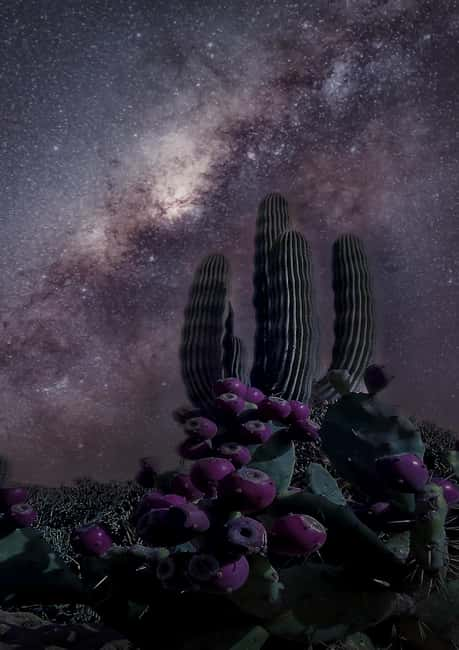
The final part of the experience is a photo stop lasting about 10 minutes. The group poses with the night sky behind it, giving you a souvenir rather than leaving you with only phone snapshots.
This is a useful extra because ordinary phone cameras often struggle in very dark conditions. The provider sends the group night photo as a keepsake, and one account also noted that additional photos arrived the next morning.
Do not expect a private portrait session. It is a group photograph, so the value is mainly in having a shared record of the evening. Still, it is a thoughtful ending, especially for families.
After the photo, you return to one of the listed drop-off points near Tabernas. The full experience lasts two hours, including the short walk, astronomy session, and photo stop.
Is $41 a fair price?
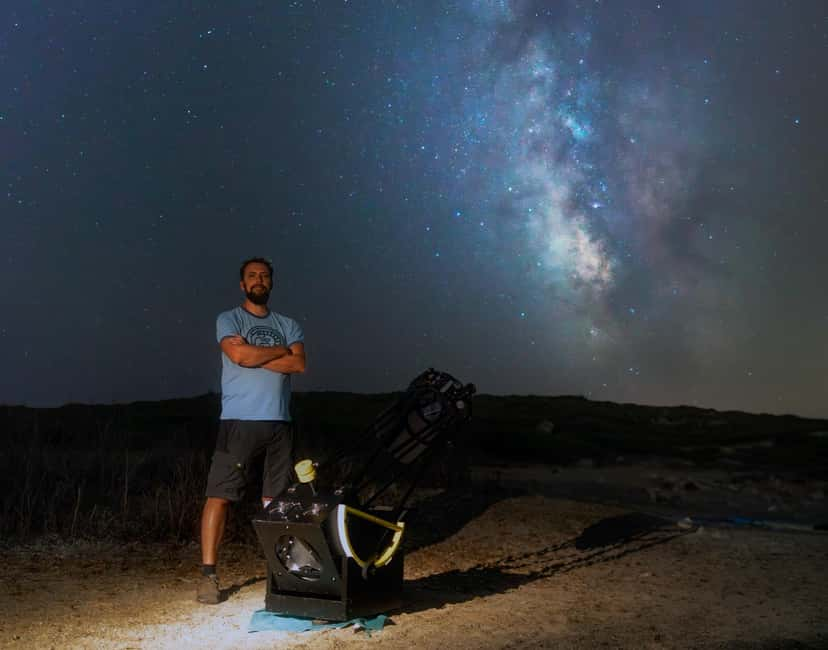
At $41 per person, this is not the cheapest way to look at the stars. You could simply drive into a dark area and look upward for free. The price makes sense if you want help understanding what you see and access to professional equipment.
You are paying for a certified astronomy monitor, two telescopes, a prepared outdoor setup, blankets, guided explanations in English or Spanish, and the group photo. The guide’s role is the biggest part of the value. Without someone who can identify objects, explain their meaning, and keep the group moving through the equipment, many first-time observers would miss much of what is above them.
The experience is also listed with more than 500 five-star ratings across different platforms for the astronomy monitor, while this activity itself has a five-star score from 19 reviews. That does not guarantee perfect weather or perfect viewing, but it does suggest a strong record of presentation and organization.
The cost is easiest to justify for families and first-time stargazers. If you already own astronomy equipment and know the night sky well, you may find the guided format less necessary. For most visitors to Tabernas who want an unusual evening activity, the combination of setting, equipment, and instruction is reasonable.
Who will enjoy this most?
I would recommend it most strongly to families with school-age children and teenagers. The chance to see the moon, planets, and star clusters through a real telescope gives children something concrete to remember, while the stories and explanations keep the adults involved.
It also suits couples, friends, and solo visitors who prefer a quiet evening rather than another restaurant or bar. The desert setting gives you a different view of Andalusia, one based on darkness and silence instead of monuments and town squares.
You should think twice if you dislike sitting on the ground, get cold easily, or want guaranteed views of a particular planet. Astronomy has limits. Clouds, wind, moonlight, and seasonal changes all matter.
The small-group option is worth choosing if available. A smaller group should make it easier to reach the telescope and ask questions, though the activity may also run with other families. The languages offered are English and Spanish, and some content may be presented in its original language.
Timing, cancellation, and planning advice
The start time is not fixed in the usual daytime-tour sense. It is always 45 minutes after sunset, and the provider contacts you about two days before the activity to check the weather and confirm the exact meeting time.
Keep the evening open around that time. The meeting point can vary according to the option booked, so do not rely only on a general map pin. Confirm the correct location before setting out.
The activity offers free cancellation up to 24 hours before the start for a full refund. You can also reserve and pay later, which helps if your Andalusia plans are still changing.
My practical packing list is short:
- Warm layers
- Comfortable shoes for the five-minute walk
- A phone with enough battery for meeting details
- Patience if the telescope queue moves slowly
- An open mind about what the weather allows
Should you book the Tabernas stargazing experience?
Book it if you want a guided introduction to astronomy in a genuinely dark outdoor setting. The strongest reasons are Gonzo’s lively teaching, the 305 mm telescope and Seestar S50, and the chance to see far more than ordinary stars, including planets, moons, clusters, binary stars, and possibly nebulae or a galaxy.
I would especially choose it for a family evening or for anyone curious about the sky but unsure where to begin. I would skip it only if sitting on the ground is uncomfortable, you need guaranteed conditions, or you already have strong astronomy skills and equipment.
For $41, you receive more than a look through a telescope. You get a way to read the night sky, a story about our connection to it, and a memorable desert evening that does not depend on another crowded sightseeing stop.
FAQ
Where does the Tabernas Desert stargazing activity begin?
There are three possible starting locations near Tabernas: 2H9F+QM Tabernas, 2H9F+QM5, and 2H9F+QM Tabernas. The exact meeting point depends on the option booked.
How long does the experience last?
The full activity lasts two hours. This includes a five-minute walk, about 105 minutes of guided astronomy, and a 10-minute photo stop.
What time does the stargazing start?
The activity begins 45 minutes after sunset. The provider contacts you about two days before the activity to check the weather and confirm the exact start time.
Which languages are available?
The live guide speaks English and Spanish. Some content may be shown in its original language.
Are chairs provided?
No. Blankets are provided for sitting or lying on the ground, but chairs are not included. If you have a back problem, contact the provider in advance and they will try to bring one.
Is the activity suitable for wheelchair users?
No. The experience is not suitable for wheelchair users. It includes a short walk and ground-level seating in the desert.
Just added around Spain
- VIP Sunset & Stargazing experience★ 4.5 · 44 reviews
- Skip the Line: Teide Observatory Entrance Ticket★ 3.0 · 33 reviews
- Small Group Teide Stargazing Tour with Picnic at Sunset★ 5.0 · 3 reviews
- TEIDE NIGHT Astronomy Stargazing Bus Tour, Meal & Drinks included!★ 4.0 · 15 reviews
- Sunset and stargazing from Teide★ 3.5 · 51 reviews
- Tenerife Exclusive & Private Gastronomic, Sunset-Stargazing★ 5.0 · 3 reviews
- PRIVATE TOUR Teide National Park: Hiking and Stargazing★ 5.0 · 38 reviews
- Sunset & Stargazing Experience from Teide★ 4.0 · 31 reviews
Telescope Stargazing, compared.
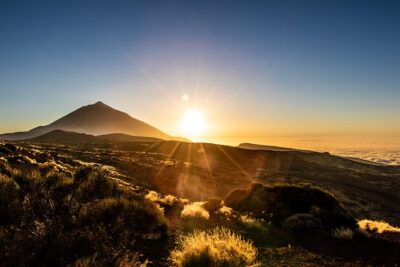
Teide by Night: Sunset & Stargazing with Telescopes Experience
Read our review →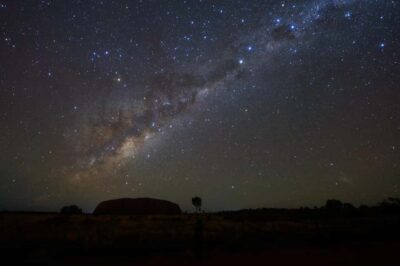
Uluru: National Park Astronomy Tour with Telescope and Photo
Read our review →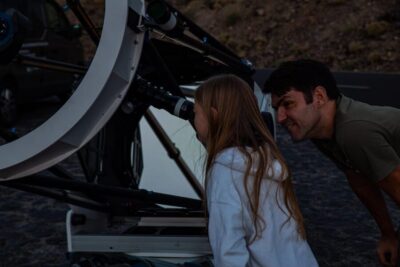
Teide National Park: Guided Large Telescope Stargazing Tour
Read our review →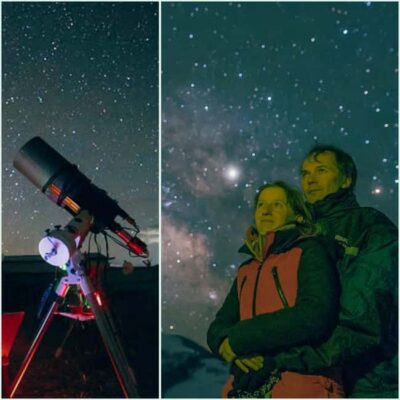
Northern Lights Tour and Stargazing by Telescope
Read our review →
Jasper Planetarium and Telescope Combo Tour Tickets
Read our review →
Cavalleria: Guided Stargazing at the Beach with Telescope
Read our review →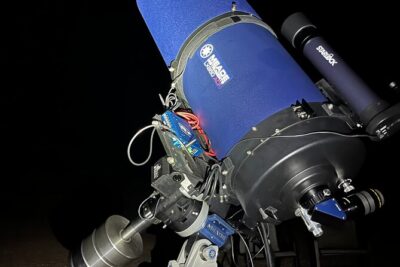
Stargazing Tour with Telescopes and Video Astronomy in Sedona
Read our review →Browse the lists this tour appears in