
Review · THE UK
Royal Observatory Greenwich & Prime Meridian Entry Ticket London
Time begins on a London hill. The Royal Observatory Greenwich combines Prime Meridian photos with a surprisingly absorbing story about clocks, longitude, and astronomy. I especially like standing with one foot in each hemisphere and seeing Harrison’s clocks, inventions that helped sailors find their way across the world. The steep walk uphill is the main catch, and the site can be awkward for anyone with limited mobility.
This is a self-guided visit rather than a traditional group tour, so you set the pace. The audio guide adds useful context, and the views across Greenwich Park toward the Thames and London make the climb worthwhile. Just allow more than a quick photo stop if you want to understand what you are seeing.
Key points to know before you go
- Stand on the Prime Meridian: Pose with one foot east and one foot west at the historic home of Greenwich Mean Time.
- See Harrison’s famous clocks: Learn how clockmaking helped solve the problem of measuring longitude at sea.
- Climb for London views: The observatory sits on a hill in Greenwich Park, with a steep approach and stairs at the attraction.
- Use the free audio guide: Language options are provided, with the information describing seven on-site choices and ten downloadable options.
- Pair it with nearby sights: The National Maritime Museum and Queen’s House are free, while Cutty Sark is a short walk away.
- Plan for about two hours: You can move quickly, but the displays and surrounding Greenwich sights reward a longer visit.
Reaching the Royal Observatory on Greenwich Hill
The Royal Observatory is not down by the river. It sits high in Greenwich Park, and getting there is part of the experience. You will walk uphill through the park, with the slope becoming noticeable as you approach the buildings.
The climb is not extreme for a reasonably fit person, but it is long enough to surprise you. Several people describe it as the least enjoyable part of the visit, especially when walking back down. If you have knee, balance, or stamina concerns, plan slowly and allow extra time.
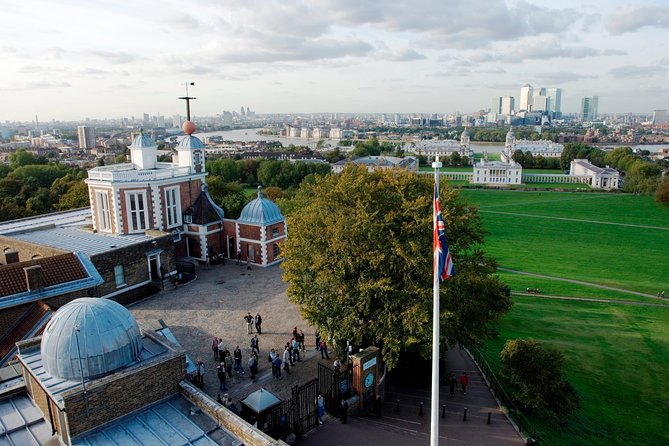
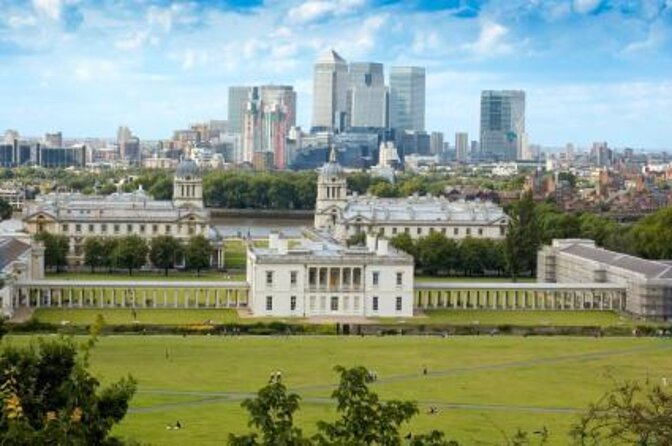
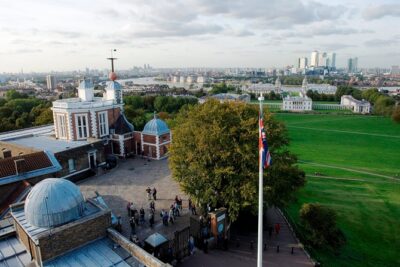
The reward comes before you even enter. From the hill, you get broad views toward the River Thames, the City of London, and the surrounding parkland. On a clear day, this is one of the best reasons to come. A ferry along the Thames can also make a pleasant way to reach Greenwich, though transportation is not included in the ticket.
The setting matters. The observatory is part of Maritime Greenwich, a UNESCO World Heritage Site. You are not walking into an isolated museum building, but into one piece of a larger historic area that includes the river, the park, the National Maritime Museum, the Queen’s House, and Cutty Sark.
More Observatory Visits in the world:
- Mount John Observatory Stargazing Experience, Tekapo
★ 4.5 · 160 reviews - Tenerife: Mount Teide Observatory Astronomical Tour
★ 4.4 · 126 reviews - Stargazing Experience at Cowan’s Private Observatory
★ 4.0 · 85 reviews
The Meridian Courtyard and the famous line
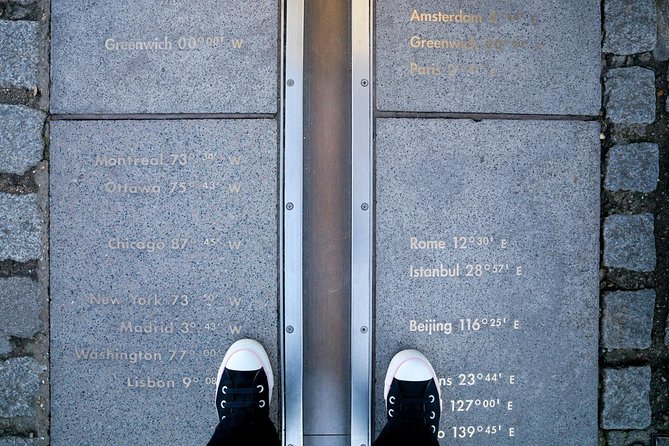
Most people have one main goal: standing astride the Prime Meridian. In the Meridian Courtyard, a marked line identifies the longitude traditionally used as the reference point for Greenwich Mean Time.
Put one foot on either side and you can pose in the east and west hemispheres at once. The science is more complicated than the souvenir photo suggests, but the moment works because this place gave the world a common way to think about longitude and time.
Go to the courtyard early if the photograph matters to you. The line is a popular stopping point, and groups can gather around it quickly. Take your picture first, then return to the displays without feeling rushed.
It is worth remembering that the line is not the whole visit. If you only arrive, take a photograph, and leave, you miss the reason the observatory became important. The indoor exhibits explain how astronomers measured time and position long before modern satellite systems made the task seem easy.
Flamsteed House and the Astronomers Royal
Your visit continues through Flamsteed House, the historic home of the Astronomers Royal. The building connects the scientific work to the people who carried it out, including figures such as John Flamsteed, Edmund Halley, James Bradley, Airy, Maunder, Newton, Harrison, and Einstein.
The details are best taken slowly. The free audio guide helps explain what the rooms were used for and why accurate observation mattered. It also gives structure to a self-guided visit, which is useful because there is no promise of a live guide accompanying you throughout.
The Octagon Room is one of the highlights. Designed by Sir Christopher Wren, it is one of the best-preserved Wren interiors in London. The room gives the visit a strong sense of place. You are not simply looking at instruments in glass cases. You are seeing the setting in which astronomical observations and calculations were made.
The building is historic and atmospheric, but it is not arranged like a modern, hands-on science center. If you want interactive entertainment at every turn, you may find it limited. If you enjoy old rooms, careful displays, and the story of how science developed through patient observation, it is much more rewarding.
Harrison’s clocks and the longitude problem
For many people, the clocks are the most interesting part of the observatory. John Harrison’s marine timekeepers helped solve one of the most difficult practical problems of the age: finding longitude at sea.
Latitude can be worked out by observing the height of the sun or certain stars. Longitude requires knowing the difference between local time and the time at a fixed reference point. A clock that could keep accurate time during a sea voyage gave sailors the information they needed.
That sounds straightforward now. It was not. A clock at sea had to cope with movement, temperature changes, humidity, and long periods away from land. Harrison’s inventions show how mechanical skill and astronomy worked together to change navigation.
This section gives the ticket much of its value. The Prime Meridian is a memorable photo, but the clocks explain why Greenwich became tied to world time. If you have little interest in astronomy, you may still find this story accessible because it is about a practical problem with enormous consequences.
The displays also help put modern timekeeping into perspective. Time zones and standard time feel ordinary now, yet they are relatively recent ideas. The visit makes that change visible.
More Tickets in the world:
- Royal Observatory Greenwich & Prime Meridian Entrance Ticket
★ 4.5 · 1,095 reviews - Miami: Frost Museum of Science and Planetarium Entry Ticket
★ 4.5 · 429 reviews - Sky View Observatory at the Columbia Center Admission Tickets
★ 3.0 · 189 reviews - Houston Museum of Natural Sciences: Planetarium Ticket
★ 4.5 · 139 reviews
The Shepherd Gate Clock and Greenwich Mean Time
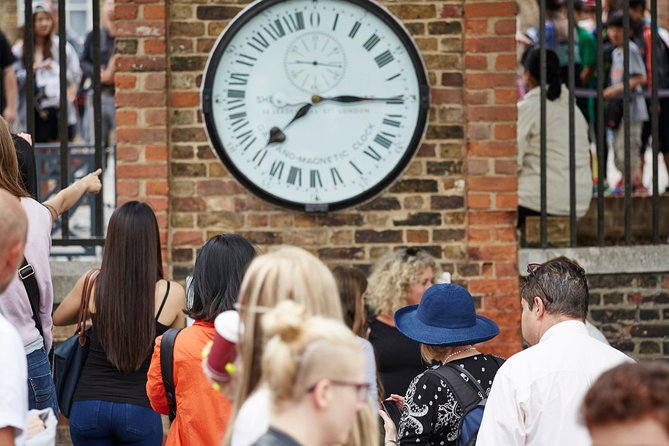
Outside Flamsteed House, look for the Shepherd Gate Clock. It was the first clock to show Greenwich Mean Time to the public.
This is a small detail, but it helps connect the observatory to everyday life. The institution did not only serve astronomers. Its time signals helped people set their own clocks, coordinate work, and understand a shared national and international time standard.
The bright red Time Ball above Flamsteed House is another easy detail to miss. First used in 1833, it remains one of the world’s earliest public time signals and still operates today. Its simple visual action made the correct time visible from a distance to ships on the Thames and people nearby.
Look up as you move around the courtyard and buildings. The observatory rewards attention to small features: clocks on walls, instruments in rooms, and signals placed outside for public use.
The Great Equatorial Telescope under the onion dome
The observatory’s large onion-shaped dome houses the Great Equatorial Telescope. The telescope gave astronomers a new view of the universe more than a century ago and remains one of the site’s most recognizable objects.
The dome and telescope add a strong astronomy element to a visit that otherwise focuses heavily on timekeeping and navigation. You can see how the observatory moved between precise measurement on Earth and the study of objects far beyond it.
Do not assume that an observatory ticket automatically includes every astronomy attraction in Greenwich. The ticket described here covers the Royal Observatory and its exhibits. A planetarium is mentioned as a worthwhile separate activity, but it is not listed among the included features, so check before you plan your day around it.
What the audio guide adds

The audio guide is free and available to download, with language information given as either seven on-site choices or ten downloadable languages. It explains the observatory, time, space, and the work of scientists associated with the site.
I would use it even if you usually skip museum audio. This visit contains names, instruments, rooms, and technical ideas that are easy to pass without context. The guide turns a collection of old clocks into a story about navigation, science, and global time.
One useful benefit is that you can control the pace. Stop for a photograph, pause at a clock, or move on when a section does not hold your interest. Some visitors also appreciated the audio in crowded areas because it allowed them to hear the explanation without relying on a nearby live talk.
A volunteer or staff talk may occasionally be available, and one particularly praised guide was Ross. Still, do not book this expecting a scheduled personal tour. Treat it as a self-guided experience with audio support.
How long to allow and how to plan the day

The stated duration is about two hours. That works for the observatory itself if you walk steadily, listen to selected audio sections, and spend time at the Meridian Courtyard, clocks, Flamsteed House, Octagon Room, and telescope.
I would allow at least two hours if the observatory is your main reason for visiting. Add more time if you want to enjoy the hilltop views, sit in Greenwich Park, or read every display.
Greenwich is especially good as a full-day outing. The National Maritime Museum and Queen’s House are within a short walk and free to enter. Cutty Sark, the surviving tea clipper, is nearby and operates as a museum and visitor attraction.
A sensible plan is to visit the observatory earlier, when the Prime Meridian line may be easier to photograph, then walk downhill for lunch and the other sights. The observatory can become crowded soon after opening, particularly during busy periods.
Rain can affect the experience. The observatory includes outdoor courtyards, the hill walk, and open views, so wet weather makes the route less pleasant. On a clear or dry day, the location is a major part of the appeal.
Price, ticket value, and booking cautions
At about $33.90 per person, this is not a bargain-priced museum visit. The value depends on what you want from it.
For someone interested in time, astronomy, navigation, or London history, the price is reasonable because it combines admission, the audio guide, historic interiors, important instruments, and the Prime Meridian experience. The nearby free museums also help make a Greenwich day more economical.
If your only aim is to stand on the line for a photograph, the ticket may feel expensive for the amount of time you spend inside. The best value comes when you treat the Meridian Courtyard as the opening scene, not the entire attraction.
There have been problems with some mobile vouchers and barcode scanners. A few people had trouble getting a phone voucher read at the entrance and had to buy another ticket on site. Make sure your ticket is accessible before you arrive, and if the barcode does not display correctly, ask staff for help before purchasing again.
The booking is normally confirmed at the time of purchase, and free cancellation is available up to 24 hours before the start time. Changes or cancellations inside that 24-hour window are not accepted for a refund.
Access, children, and who will enjoy it most
Children under four enter free, and children must be accompanied by an adult. The subject works well for families because the Prime Meridian gives children a simple physical idea of east and west, while the clocks and telescope provide concrete objects to look at.
The site is not fully accessible. The hill is steep, there are stairs, and internal lifts are not available throughout the historic buildings. One small external lift covers a short set of steps, but it does not solve every access problem.
If you use a wheelchair or have serious mobility concerns, contact the attraction before visiting so you can plan with accurate information. Service animals are allowed, and most people can take part, but the walk and historic layout deserve careful thought.
I would recommend the observatory most strongly to:
- Families who want an educational Greenwich outing
- Couples and solo visitors interested in science or old instruments
- Anyone who enjoys London views and historic buildings
- People already planning to visit the National Maritime Museum or Cutty Sark
- Visitors who like self-guided sightseeing rather than a fixed group schedule
You may be less satisfied if you want a modern planetarium experience, a live guide for the full visit, or an easy step-free attraction.
Should you book the Royal Observatory Greenwich ticket?
Yes, if you want more than a photograph. The Prime Meridian line is fun, but Harrison’s clocks, the Octagon Room, the Shepherd Gate Clock, the Time Ball, and the Great Equatorial Telescope give the visit real substance.
Book it as part of a Greenwich day rather than an isolated two-hour stop. Wear comfortable shoes, allow time for the uphill walk, arrive early for the clearest Meridian photo, and download the audio guide before you enter.
I would skip it only if steep hills and stairs are a serious problem, or if you are expecting a planetarium or a fully guided tour. For everyone else, the observatory offers a clear, memorable look at how people learned to measure time, find their position, and share one global clock.
FAQ
How long does the Royal Observatory visit take?
The visit lasts approximately two hours. You may want longer if you plan to spend time in Greenwich Park or visit nearby attractions.
What is included in the ticket?
The ticket includes admission to the Royal Observatory, the audio guide, and all fees and taxes. The National Maritime Museum and Queen’s House are nearby and free to visit, but they are separate attractions.
Can I stand on the Prime Meridian?
Yes. The Meridian Courtyard has the Prime Meridian line, where you can pose with one foot in the east and one in the west.
Is the audio guide included?
Yes. A free audio guide is available to download. The information describes language options as seven on-site choices and ten downloadable languages.
Is transportation included?
No. You must arrange your own transportation to and from the Royal Observatory.
Is the Royal Observatory suitable for children?
Yes. Children can enter, and those under four are free. Children must be accompanied by an adult.
Is the observatory wheelchair accessible?
Certain parts are not fully accessible. The observatory is on a steep hill and includes stairs, so contact the attraction before your visit if you need assistance planning access.
Is the planetarium included?
The ticket information does not list a planetarium as an included feature. Check separately if you want to add a planetarium visit.
Can I cancel the ticket for a refund?
You can cancel up to 24 hours before the experience start time for a full refund. Cancellations and changes made less than 24 hours beforehand are not accepted.
Just added around the world
- ( canyon hurghada & stargazing )★ 4.9 · 16 reviews
- Vincentia: Jervis Bay Beach Stargazing with an Expert★ 4.9 · 19 reviews
- Twizel Stargazing Experience with a Guide (Carbon Positive)★ 4.7 · 26 reviews
- Twizel: Stargazing Tour with an Astronomer and Telescope★ 4.9 · 36 reviews
- Blue Mountains: Stargazing with a Telescope and Astronomer★ 4.4 · 21 reviews
- Star Safari Stargazing Experience, Martinborough★ 5.0 · 6 reviews
- Klein Karoo “High 5” Stargazing Experience in Oudtshoorn★ 5.0 · 7 reviews
- VIP Sunset & Stargazing experience★ 4.5 · 44 reviews
Observatory Visits, compared.
Royal Observatory Greenwich & Prime Meridian Entrance Ticket
Read our review →
Griffith Observatory Hike: Guided Tour through Griffith Park
Read our review →


Sky View Observatory at the Columbia Center Admission Tickets
Read our review →Browse the lists this tour appears in